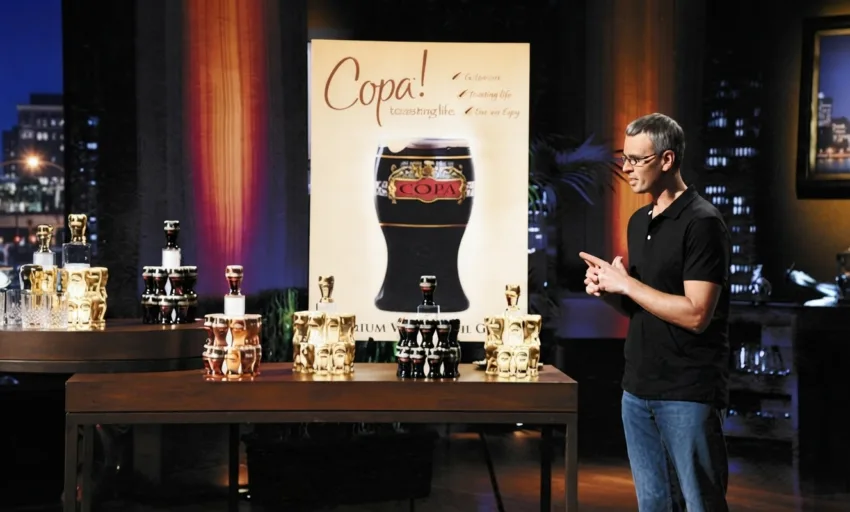
Copa di Vino net worth has become a popular search topic because the wine company became one of the most memorable businesses to appear on Shark Tank. Founded by entrepreneur James Martin, Copa di Vino introduced a simple but unusual idea: premium wine served in a single-serve glass that could be opened and enjoyed without a bottle, corkscrew, or traditional wine glass. The business attracted national attention after Martin appeared on Shark Tank more than once and famously walked away without making a deal.
In this article, we look at the company’s history, James Martin’s background, the famous Shark Tank pitches, sales growth, acquisition by Splash Beverage Group, product lineup, and what can reasonably be said about the business’s financial position. The goal is to give readers a clearer picture instead of relying on one unsupported net-worth number.
Copa di Vino Net Worth in 2026
Copa di Vino net worth is difficult to state as one exact number because Copa di Vino was acquired by Splash Beverage Group in 2020 and the public information available about the transaction does not establish a current personal net worth for James Martin. The acquisition was reported at approximately $5.98 million, but that figure represents the transaction value for the business rather than Martin’s personal wealth.
For that reason, the safest answer is that there is no reliably verified public figure for James Martin’s personal net worth in 2026. The better-known financial figure connected directly to Copa di Vino is the roughly $5.98 million acquisition announced by Splash Beverage Group.
Why the Numbers Online Are Different
Search results for Copa di Vino net worth can show dramatically different figures because some websites calculate an estimated company value from revenue, while others repeat historical valuations from the company’s Shark Tank appearances. A revenue estimate is not the same thing as a company’s market value, and neither automatically represents the founder’s personal wealth.
This distinction matters because Martin owned and developed the company, but the final proceeds from a business sale depend on ownership percentages, liabilities, transaction terms, taxes, and other financial details. Without a complete public accounting of those factors, it is not possible to calculate his personal wealth precisely.
Company Value vs. Personal Net Worth
A company’s valuation describes what a business may be worth to investors or buyers. Personal net worth is the value of an individual’s assets minus liabilities. The two figures can be very different.
Copa di Vino’s history illustrates why this difference is important. The company was once discussed at valuations much higher than the later reported acquisition price, while its founder’s personal financial position was never publicly disclosed in enough detail to produce a dependable current figure.
Who Is James Martin?
James Martin is the entrepreneur behind Copa di Vino and a member of the Martin family associated with agriculture and winemaking in The Dalles, Oregon. His family had been connected to the area for generations, and Martin eventually became interested in building a winery and developing a different way to package wine.
Martin’s background was not limited to traditional winemaking. Before focusing heavily on wine, he had experience in technology and business, and he eventually returned to his family’s community. His combination of technology interests, wine experience, and entrepreneurial thinking helped lead to the development of Copa di Vino.
James Martin and the Wine Industry
Martin’s connection to wine developed through his family winery and his interest in making wine easier to serve. Instead of treating wine only as a traditional bottled product, he saw an opportunity to change the way consumers could enjoy an individual serving.
The result was Copa di Vino, which placed wine into a specially designed single-serve container. The concept was aimed at situations where carrying a bottle and glass would be inconvenient, such as outdoor events, sporting venues, concerts, travel, and other casual occasions.
How Copa di Vino Started
The story behind Copa di Vino began with Martin’s experience in France. According to the company’s own history, he was traveling by bullet train through southern France and became interested in the possibility of enjoying quality wine without the traditional bottle and glass setup. He later returned to Oregon and worked on developing the concept.
The idea sounded simple, but packaging wine in a single-serving format created technical challenges. Wine is sensitive to oxygen, and maintaining quality and shelf life in an alternative package required more than simply pouring wine into a small container.
Martin and his team worked on packaging technology that could protect the wine while providing a convenient drinking experience. The final product was designed as a contoured single-serving glass with a sealed top.
The Problem Copa di Vino Solved
Traditional wine is usually sold in bottles that require a corkscrew or another opening method. Once opened, the bottle can also be inconvenient when a person only wants one glass.Copa di Vino addressed that problem by putting an individual serving into a ready-to-drink format. The concept was particularly attractive to businesses and venues that wanted to offer wine by the glass without opening full bottles for every customer.
The company eventually promoted several wine varieties, including Cabernet Sauvignon, Chardonnay, Merlot, Moscato, Pinot Grigio, Riesling, and White Zinfandel.

Copa di Vino on Shark Tank
Copa di Vino became nationally recognized after James Martin appeared on Shark Tank. The first appearance is especially remembered because Martin entered the show seeking investment but did not leave with a deal.
The pitch focused on the convenience of premium wine in a single serving. Martin believed the packaging could open new opportunities in stadiums, events, restaurants, retail stores, and outdoor locations. His confidence attracted attention from the Sharks, but negotiations did not result in a completed investment. Instead of accepting terms he considered unfavorable, Martin walked away.
The First Shark Tank Pitch
During the first appearance, Martin asked for $600,000 in exchange for 20% of Copa di Vino. That request placed the company’s implied valuation at approximately $3 million at the time of the pitch.
The product already had commercial potential, but the Sharks questioned aspects of the business, including the valuation and investment terms. Martin ultimately left without a deal. His decision became one of the reasons the company continued to attract attention after the episode.
Martin Returned to Shark Tank
Martin later returned to the show for another attempt. The second appearance became just as memorable because he again refused to accept a deal that did not meet his expectations.
By that point, the business had grown substantially. The company had stronger sales, greater distribution, and a more established position in the single-serve wine market.
Martin’s two appearances became a major part of the Copa di Vino story because the company demonstrated that a business could continue growing even after walking away from the Sharks.If readers want a broader background on the television series that made the company famous, they can learn more about Shark Tank.
Copa di Vino Sales and Growth
Copa di Vino net worth discussions often focus on revenue because sales growth was one of the most impressive parts of the company’s story. The company reportedly moved from early-stage sales to millions of dollars in annual revenue as distribution expanded.
Older reports stated that Copa di Vino had reached significant retail distribution and was generating millions in sales. Some later reports placed annual revenue around $6 million during the period after the acquisition.
The company’s growth was driven by more than television exposure. Its packaging offered a practical solution for retailers, venues, and customers who wanted individual servings of wine without opening a traditional bottle.
Expansion Into Retail
One of the biggest advantages of Copa di Vino was its ability to fit into different sales environments. Instead of competing only with bottled wine on traditional shelves, the product could be marketed as a convenient single serving.
Before the acquisition, the company had expanded into thousands of retail locations. Splash Beverage Group later described the brand as having distribution across more than 13,000 retail locations and additional e-commerce opportunities.That distribution gave Copa di Vino a much larger market presence than a small regional winery.
Why the Product Stood Out
The main selling point was convenience. Customers did not need to carry a bottle, open it, or find a separate glass.
The packaging also helped businesses control portions. A venue could sell one serving instead of opening a full bottle and worrying about the remaining wine.This made the product especially interesting for events and locations where traditional glass bottles could be difficult to manage.
Copa di Vino Acquisition
One of the most important events in the company’s financial history came in December 2020, when Splash Beverage Group finalized its acquisition of Copa di Vino. The transaction was reported at approximately $5.98 million, along with the assumption of certain liabilities.
The acquisition gave Splash Beverage Group control of the brand and its packaging technology while allowing Martin to remain involved for a period as the founder and Chief Innovation Officer. This event is important when researching Copa di Vino net worth because it provides a concrete financial figure connected to the company. However, it still does not tell us exactly how much money James Martin personally received or what his total wealth became after the sale.
Martin’s Role After the Acquisition
Documents connected with the transaction show that Martin entered into an employment agreement with Splash Beverage Group and served as Copa di Vino Founder and Chief Innovation Officer. The agreement included an annual salary of $175,000 and potential retention bonuses.
This role shows that the relationship between Martin and the brand continued after the acquisition. He was not simply separated from the company immediately after the transaction. His knowledge of the packaging system, product development, and wine business made him valuable to the acquiring company.
What Happened to Copa di Vino After Shark Tank?
Copa di Vino’s story did not end when Martin walked away from the Sharks. In fact, the company continued expanding and eventually became attractive enough to be acquired.
This is one reason the business is frequently discussed among notable Shark Tank companies. Martin’s refusal to accept an investment did not prevent the company from growing. The brand’s development also showed that television exposure can be useful even when an entrepreneur does not make a deal. The Shark Tank appearances created awareness that helped put the product in front of a much larger American audience.
Did Copa di Vino Get a Deal on Shark Tank?
No, James Martin did not complete a deal with the Sharks during his appearances. He received offers but ultimately chose not to accept the terms presented to him.
That decision became a major part of the company’s identity. Instead of being remembered as a business that received Shark funding, Copa di Vino became known as a company that appeared on the show and continued growing independently.
Copa di Vino Products
The product line has included several popular wine varieties. Company and distribution information has listed Cabernet Sauvignon, Chardonnay, Merlot, Moscato, Pinot Grigio, Riesling, and White Zinfandel among the brand’s offerings.
The single-serving format was the central feature across the product line. Rather than changing the basic idea for each wine, Copa di Vino used its packaging concept to create a consistent experience across different varieties. The design also helped establish a recognizable visual identity. The container looked different from conventional wine bottles, which made the product easier to recognize on retail shelves.
Wine by the Glass
Copa di Vino’s basic concept can be described as wine by the glass without the traditional glass. The serving was packaged in a container designed to resemble the experience of having an individual glass of wine.
That idea was particularly useful for consumers who wanted a single serving instead of committing to an entire bottle. For businesses, the format could also reduce waste because each serving was already portioned.
Business Challenges
Despite its success, Copa di Vino faced challenges that are common in the beverage industry. Wine companies have to manage production, packaging, distribution, retail relationships, regulations, branding, and consumer preferences.
The single-serve concept also required specialized packaging technology. Producing wine in a nontraditional format can create additional manufacturing and quality-control requirements. There were also legal and business disputes connected with the broader operations surrounding Martin and his companies. Those matters show that entrepreneurial success does not always mean a business operates without complications.
The Importance of Distribution
For a beverage company, having a good product is only part of the equation. The product must also reach customers consistently.
Copa di Vino’s expansion into thousands of retail locations helped the brand move beyond the original winery concept. Distribution gave the company access to consumers who had never visited the Martin family’s Oregon operation. That scale was one of the factors that made the company more attractive as an acquisition target.
Is Copa di Vino Still in Business?
Copa di Vino’s ownership changed after the Splash Beverage Group acquisition, so it is important to distinguish the brand from the original independent company founded by Martin.
The brand has continued to be associated with single-serve wine and the distinctive packaging concept. Current online business listings and the company’s own materials continue to present Copa di Vino as a wine brand. However, the exact corporate structure, ownership position, and current financial performance should not be confused with the numbers reported during the company’s earlier independent growth period.
James Martin’s Entrepreneurial Strategy
Martin’s approach was different from many entrepreneurs who appear on business reality television. He was willing to protect his ownership position rather than accept an investment simply because it came with national exposure.
That decision carried risk. Turning down investors means an entrepreneur must continue finding ways to finance growth, manage operations, and build distribution. In Martin’s case, the company eventually developed enough scale to attract an acquisition from a larger beverage business.
Building Value Without a Shark
The Copa di Vino story is a useful example of how a founder can create value without giving away equity during a television pitch.
The company’s success came from a combination of product differentiation, packaging technology, distribution, branding, and consumer convenience. The Shark Tank appearances provided publicity, but the business still had to execute after the cameras stopped. This is an important reason not to judge the company only by whether it received a deal on the show.
What Can We Learn From Copa di Vino?
One of the biggest lessons is that a simple consumer problem can lead to a scalable business idea. Martin identified a common inconvenience: enjoying one serving of wine often required opening a bottle and using separate glassware.
The solution did not require inventing a new type of wine. Instead, it changed the packaging and consumption experience. Another lesson is the importance of knowing the value of a business. Martin’s negotiations on Shark Tank showed that founders must understand how much ownership they are willing to give up and under what conditions.
Convenience Can Create a Market
Copa di Vino also demonstrates how convenience can influence purchasing behavior. Consumers often choose products that save time, reduce waste, or make an existing activity easier.
The brand applied this idea to wine by creating a portable, single-serving format. That positioning helped Copa di Vino stand apart from traditional bottled wine and gave the company opportunities in venues where bottles were not always practical.
Copa di Vino Net Worth vs. Shark Tank Valuation
Copa di Vino net worth is sometimes reported using a company valuation from a specific year. For example, historical coverage has referenced a valuation of about $70 million during the company’s growth period.
That number should be treated as a historical business valuation rather than a current 2026 figure. Company valuations can change significantly depending on revenue, growth expectations, assets, liabilities, buyers, and market conditions. The later acquisition provides another useful data point, but the reported acquisition value of about $5.98 million does not automatically mean the company was always worth that amount or that Martin personally received that entire amount.
Copa di Vino Net Worth and James Martin’s Wealth
When people search for Copa di Vino net worth, they are often really asking how much James Martin made from the company. Unfortunately, public records do not provide enough information to calculate his complete personal net worth with confidence.
Martin’s wealth could include money from the business, other investments, real estate, employment income, winery operations, and other assets. Without a complete personal financial statement, any exact number would be speculative. The most responsible approach is therefore to focus on documented business milestones instead of repeating an unsupported personal net-worth estimate.
Frequently Asked Questions
What is Copa di Vino net worth?
There is no verified public 2026 personal net-worth figure for James Martin, while the company was acquired for about $5.98 million.
Who founded Copa di Vino?
James Martin founded Copa di Vino and developed its single-serve wine concept.
Did Copa di Vino get a Shark Tank deal?
No, James Martin appeared on the show and ultimately walked away without accepting a deal.
Who bought Copa de Vino?
Splash Beverage Group finalized the acquisition of Copa di Vino in December 2020.
Is Copa di Vino still available?
The brand continues to be associated with single-serve wine products and its distinctive packaging concept.
Final Thoughts
Copa di Vino net worth is difficult to reduce to one exact number because the available figures refer to different stages of the company’s history. James Martin built Copa di Vino from an innovative wine-packaging idea into a widely distributed brand, appeared on Shark Tank twice without accepting a deal, expanded the business significantly, and eventually sold it to Splash
Beverage Group in a transaction reported at approximately $5.98 million. The company’s story is more useful than any unsupported personal net-worth estimate because it shows how product innovation, smart positioning, distribution, and ownership decisions can turn a simple idea into a recognizable American beverage business.
You Can Must Read About Our Latest Article: ”Biggie Baddies Net Worth”
